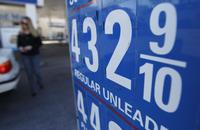
"Feeling pain at the pump? Gas prices have doubled since Mr. Obama took office. According to the GasBuddy gasoline price tracking web site, the price of a gallon of regular gas was around $1.79 when Mr. Obama took office. Today the national average is $3.58. The lowest average price in the continental United States is $3.31 in Tulsa Oklahoma, the highest is $4.14 in Santa Barbara, CA. Four-dollar-a-gallon gas has arrived on average throughout California, and a number of other states are headed in that direction."
News, business, and commentary concerning energy security and independence and how Kentucky government and business can be leaders in making America energy secure.
Thursday, March 31, 2011
Washington Times: Gasoline up 100% under Obama
Monday, March 21, 2011
The Telegraph: Obama says US to be major purchaser of Brazilian oil
For more on this story click here."I have told her that the United States wants to be a major customer, which can be a win-win for both our countries," [Barack Obama said].
Another stellar failure of vision that brings America energy security and independence. Ironically, Brazil is nearly 100% energy independent, by producing 98% of its transportation fuel needs from biomass. What is further adding insult to injury on the part of the Obama's move to increase oil imports from Brazil is the fact they are producing enough ethanol from biomass to become a net exporter of that as well.
When are the politicians in Washington going to get their priorities straight and answer the needs of the people with a clearly defined and effective energy security plan that unleashes domestic energy production in all areas, coal, natural gas, oil, biomass, and renewables?
We need to demand it, while recognizing American domestic energy development will create good-paying jobs and break the grip of foreign oil interests on our nation's economy and future.
Friday, March 11, 2011
Thursday, March 10, 2011
Gas Prices Skyrocket 67% Since Obama Took Office
| Obama Fiddles while consumer fuel costs skyrocket 67% |
"Now obviously turmoil in the Middle East has something to do with our current astronomical gas prices, but keep in mind that by this point in the Bush presidency 9/11 had happened and we were on the verge of invading Iraq. So while the president can't be entirely responsible for global commodity prices, it's still worth asking what Obama's doing to make things worse."
For more information on the analysis visit The Weekly Standard.Where is the outrage from the media about the huge increase under Obama? The same media were quick to point to the increase in fuel prices under President Bush as a huge increase, blaming the Bush Administration for the comparatively small increases against the 67% under Obama.
The outrage here is there has been a failure since the Carter Administration to chart a true course to energy security and break the grip of OPEC over not only the American consumer at the pump, but over American mlitary and foreign policy as well. It is the proverbial 'Emperor Nero' Obama fiddling while American economy and the consumer suffocates under rising fuel prices.
Political leaders need to act now to empower the private sector to lead America to energy security.
Wednesday, March 9, 2011
Reuters: Gasoline cost to jump $700 for average household
The average U.S. household will spend about $700 more for gasoline in 2011 than it spent last year, bringing total motor fuel expenses up 28 percent to $3,235, based on an annual pump price of $3.61 a gallon, the department's Energy Information Administration said.
For more on this story click here
If the current increase in the price of crude oil and the price of gasoline at the American pump happened from 2001-2008, the media and the Left would have been pointing the finger at President Bush. However, since we have Carter II in the White House, with the United States facing increasing economic troubles, as well as new and expanding threats in the Middle East, the mainstream media does not make the connection between the failure of Obama to provide any foreign policy leadership or any leadership that would implement a comprehensive energy policy--a hallmark of his 2008 Presidential campaign.
What we are now facing is the spectre of $5.00/gallon gasoline and a double-hit against an already weakened economy. The time is now to hold accountable Barack Obama, to demand action by Congress to pass a 'Marshall Plan' for Energy Security. By replacing 30% of the OPEC crude with domestically-produced transportation fuel, the United States can create solid, good-paying jobs and break the grip of the OPEC cartel on the United States.
It is a sad fact that families and small business see rising fuel and food bills and the political leaders in this country, at both the federal and state levels, continue to stick their heads in the proverbial sand.
Friday, December 4, 2009
Free Webinar - Green Jobs: What They Are and How to Find Them
With the increased focus on clean energy, experts say 'green' employment opportunities will grow significantly. If you're a job-seeker, it can be hard to find practical information about green jobs. What are these jobs, exactly? How do you find out about them? Who are the 'green' employers in your area?"
Monday, October 26, 2009
Wednesday, October 21, 2009
Does LNG Place America at Risk?
According to an Institute for Analysis of Global Security (IAGS) study, The Terrorist Threat to Liquefied Natural Gas: Fact or Fiction, a study found that “on 14 February 2007, the Saudi Arabian arm of al-Qaeda put out a call to all religious militants to attack oil and natural gas sources around the world.” Al-Qaeda plans to strangle the United States economy through severe disruption of foreign energy supplies imported for domestic use. This disruption will include LNG, as well as crude oil, tankers and land-based facilities.
As late as May 2009, LNG safety was called into question in Baltimore, Maryland, where “opponents of a liquefied natural gas terminal in eastern Baltimore County stepped up their attacks Tuesday, hosting an appearance by a former CIA officer [Charles Faddis] who said the $400 million project lacks critical safeguards and raises the specter of terrorism and piracy”, according to a news report in the Baltimore Sun.
That sentiment was shared by Maryland State Senator Norman R. Stone, Jr., who stated: “The possibility of terrorism or catastrophic accident outweighs the promise of jobs [and] Faddis' expertise ‘lends credence to what we know could happen here’".
In the Energy Bulletin, the world’s second largest insurer, Lloyd’s of London, warned earlier in 2004 about the risk of terrorist naval attacks against LNG and crude oil tankers. In voicing that concern, Peter Levene, said that if terrorist were able to successfully attack a LNG tanker it "would have the force of a small nuclear explosion”. This speech was delivered in Houston, Texas, where many LNG and crude oil refineries exist raising the concern about the construction of those types of facilities being built in Kentucky.
The risk created by the construction of LNG facilities and the utilization of LNG for transportation fuel presents major national security, environmental concern, and disaster response problems for federal, state, and local governments. From terror attacks to disaster response capabilities of local first responders, i.e. fire departments and emergency management, LNG alters the domestic energy landscape in a potentially negative fashion.
“Once ignited, as is very likely when the spill is initiated by a chemical explosion, the floating LNG pool will burn vigorously…Like the attack on the World Trade Center in New York City, there exists no relevant industrial experience with fires of this scale from which to project measures for securing public safety.”-- Professor James Fay, Massachusetts Institute of TechnologyA 2007 Government Accountability Office (“GAO”) report issued called into question the public safety should an LNG facility explode or become the target of terrorist attack. The GAO study showed that experts polled as part of that study agreed that “one to 1.25 miles was not a sufficiently conservative estimate to describe the heat hazard zone of an LNG related fire. If the experts who disagreed with this distance happen to be correct, it would put members of the general population located at the questionable threshold of 1.2 or 1.3 miles away from the site in a risky location.” Clearly, local volunteer fire departments would not have the manpower or resources should a LNG facility or fueling site explod or catch fire.
All evidence suggests the proper path for natural gas transportation fuel development leads to the use of compressed natural gas (“CNG”) or propane. Both CNG and propane represent an efficient, safe, and environmentally-sound transportation fuel source derived from natural gas. No environmental or hazardous dangers exist. In fact, CNG dissipates should a leak occur. It does not explode; being very similar to the propane presently used by thousands of consumers in their homes right now.
As a transportation fuel, CNG provides the same fuel benefits as LNG without the risk or the cost of storing and maintaining LNG. For convenience stores, CNG is a manageable and safe alternative fuel. It does not present a national security concern and can be produced domestically, without having to import vast quantities from countries such as Saudi Arabia, Iran or Russia.
According to the Natural Gas Alliance, the U.S. has over 100 years of domestic natural gas that can be utilized safely and efficiently for transportation fuel, without processing it into LNG. The solution for natural gas as transportation fuel is CNG. Safe, efficient, and secure, CNG provides a viable alternative fuel. We can develop CNG as a viable transportation without resorting to the use of LNG. With vast natural gas reserves, any move to import and transport LNG should be evaluated as to the grave risk of increased homeland terrorist attacks, as well as concerns for the safety of consumers and the protection of the environment. These concerns must be answered before any business or local government attempts to utilize LNG for transportation fuel.
Thursday, October 8, 2009
Coal Jobs Are At Stake and the Future of the Kentucky Economy!
The first proposal is to modify NWP 21 to prohibit its use in the Appalachian region. In the absence of NWP 21, an applicant would be required to obtain an individual permit for surface coal mining projects. An individual permit includes increased public and agency involvement in the permit review process, including an opportunity for public comment on individual projects.
The second proposal is to suspend NWP 21 while the Corps evaluates the comments received on the proposed modification of NWP 21, and reaches its decision. The decision on whether to suspend NWP 21 will be made after the public hearings are held and the comments received on the proposed suspension have been considered.
If NWP 21 is suspended during this interim period, an applicant would be required to obtain an individual permit for surface coal mining projects.
It appears that others agencies will become part of the new permit proposal process – EPA, Fish & Wildlife, Office of Water, Office of Clean Air, and more Public Participation.
We must join together educating and informing our people as to the devastating impact this will have on the people living in the Appalachian Region and/or particularly southern West Virginia, eastern Kentucky, and southwest Virginia.
We need to have a strong presence at all the hearings and will notify as many people as possible. The Coal Council will organize and work with others to get people to the Virginia and Tennessee hearings. The WV Coal Association will be able to get a crowd to the Charleston, WV hearing – the PA Coal Association will be able to get a crowd for the Pennsylvania hearing – the KY Coal Association and other KY coal groups will be able to get a crowd to the Pikeville hearing – and the OH Coal Association will be able to get a crowd to the Ohio hearing.
Can we count on you and your company to attend these important hearings? The time is now to take action! If something is not done to stop the NWP 21 change, it will devastate the entire coal industry and the economies of Kentucky and other coal-producing states.
Please send this message to your family, friends and business colleagues and ask them to support our efforts.
Tuesday, September 1, 2009
A Message from Eastern Coal Council and National Mining Association
Please click on the link below and let the Senators know how you feel about the Waxman-Markey Climate Bill. Click to sign the petition on this link.
Sign the Petition because it:
- Cost jobs in my community,
- Unfairly place new cost burdens on families in select states while people living in most wealthy states pay nothing,
- Further hurt the U.S. economy, and
- Jeopardize our energy security
Frank Gaffney: The Nexus Between Energy & Security
Frank Gaffney spoke to the Reserve Officers' Association as part of a day-long program on energy security.