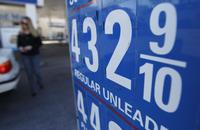
"Feeling pain at the pump? Gas prices have doubled since Mr. Obama took office. According to the GasBuddy gasoline price tracking web site, the price of a gallon of regular gas was around $1.79 when Mr. Obama took office. Today the national average is $3.58. The lowest average price in the continental United States is $3.31 in Tulsa Oklahoma, the highest is $4.14 in Santa Barbara, CA. Four-dollar-a-gallon gas has arrived on average throughout California, and a number of other states are headed in that direction."
News, business, and commentary concerning energy security and independence and how Kentucky government and business can be leaders in making America energy secure.
Thursday, March 31, 2011
Washington Times: Gasoline up 100% under Obama
Monday, March 21, 2011
The Telegraph: Obama says US to be major purchaser of Brazilian oil
For more on this story click here."I have told her that the United States wants to be a major customer, which can be a win-win for both our countries," [Barack Obama said].
Another stellar failure of vision that brings America energy security and independence. Ironically, Brazil is nearly 100% energy independent, by producing 98% of its transportation fuel needs from biomass. What is further adding insult to injury on the part of the Obama's move to increase oil imports from Brazil is the fact they are producing enough ethanol from biomass to become a net exporter of that as well.
When are the politicians in Washington going to get their priorities straight and answer the needs of the people with a clearly defined and effective energy security plan that unleashes domestic energy production in all areas, coal, natural gas, oil, biomass, and renewables?
We need to demand it, while recognizing American domestic energy development will create good-paying jobs and break the grip of foreign oil interests on our nation's economy and future.
Thursday, March 10, 2011
Gas Prices Skyrocket 67% Since Obama Took Office
| Obama Fiddles while consumer fuel costs skyrocket 67% |
"Now obviously turmoil in the Middle East has something to do with our current astronomical gas prices, but keep in mind that by this point in the Bush presidency 9/11 had happened and we were on the verge of invading Iraq. So while the president can't be entirely responsible for global commodity prices, it's still worth asking what Obama's doing to make things worse."
For more information on the analysis visit The Weekly Standard.Where is the outrage from the media about the huge increase under Obama? The same media were quick to point to the increase in fuel prices under President Bush as a huge increase, blaming the Bush Administration for the comparatively small increases against the 67% under Obama.
The outrage here is there has been a failure since the Carter Administration to chart a true course to energy security and break the grip of OPEC over not only the American consumer at the pump, but over American mlitary and foreign policy as well. It is the proverbial 'Emperor Nero' Obama fiddling while American economy and the consumer suffocates under rising fuel prices.
Political leaders need to act now to empower the private sector to lead America to energy security.
Wednesday, March 9, 2011
Reuters: Gasoline cost to jump $700 for average household
The average U.S. household will spend about $700 more for gasoline in 2011 than it spent last year, bringing total motor fuel expenses up 28 percent to $3,235, based on an annual pump price of $3.61 a gallon, the department's Energy Information Administration said.
For more on this story click here
If the current increase in the price of crude oil and the price of gasoline at the American pump happened from 2001-2008, the media and the Left would have been pointing the finger at President Bush. However, since we have Carter II in the White House, with the United States facing increasing economic troubles, as well as new and expanding threats in the Middle East, the mainstream media does not make the connection between the failure of Obama to provide any foreign policy leadership or any leadership that would implement a comprehensive energy policy--a hallmark of his 2008 Presidential campaign.
What we are now facing is the spectre of $5.00/gallon gasoline and a double-hit against an already weakened economy. The time is now to hold accountable Barack Obama, to demand action by Congress to pass a 'Marshall Plan' for Energy Security. By replacing 30% of the OPEC crude with domestically-produced transportation fuel, the United States can create solid, good-paying jobs and break the grip of the OPEC cartel on the United States.
It is a sad fact that families and small business see rising fuel and food bills and the political leaders in this country, at both the federal and state levels, continue to stick their heads in the proverbial sand.
Friday, December 4, 2009
Free Webinar - Green Jobs: What They Are and How to Find Them
With the increased focus on clean energy, experts say 'green' employment opportunities will grow significantly. If you're a job-seeker, it can be hard to find practical information about green jobs. What are these jobs, exactly? How do you find out about them? Who are the 'green' employers in your area?"
Monday, October 26, 2009
Wednesday, October 21, 2009
Does LNG Place America at Risk?
According to an Institute for Analysis of Global Security (IAGS) study, The Terrorist Threat to Liquefied Natural Gas: Fact or Fiction, a study found that “on 14 February 2007, the Saudi Arabian arm of al-Qaeda put out a call to all religious militants to attack oil and natural gas sources around the world.” Al-Qaeda plans to strangle the United States economy through severe disruption of foreign energy supplies imported for domestic use. This disruption will include LNG, as well as crude oil, tankers and land-based facilities.
As late as May 2009, LNG safety was called into question in Baltimore, Maryland, where “opponents of a liquefied natural gas terminal in eastern Baltimore County stepped up their attacks Tuesday, hosting an appearance by a former CIA officer [Charles Faddis] who said the $400 million project lacks critical safeguards and raises the specter of terrorism and piracy”, according to a news report in the Baltimore Sun.
That sentiment was shared by Maryland State Senator Norman R. Stone, Jr., who stated: “The possibility of terrorism or catastrophic accident outweighs the promise of jobs [and] Faddis' expertise ‘lends credence to what we know could happen here’".
In the Energy Bulletin, the world’s second largest insurer, Lloyd’s of London, warned earlier in 2004 about the risk of terrorist naval attacks against LNG and crude oil tankers. In voicing that concern, Peter Levene, said that if terrorist were able to successfully attack a LNG tanker it "would have the force of a small nuclear explosion”. This speech was delivered in Houston, Texas, where many LNG and crude oil refineries exist raising the concern about the construction of those types of facilities being built in Kentucky.
The risk created by the construction of LNG facilities and the utilization of LNG for transportation fuel presents major national security, environmental concern, and disaster response problems for federal, state, and local governments. From terror attacks to disaster response capabilities of local first responders, i.e. fire departments and emergency management, LNG alters the domestic energy landscape in a potentially negative fashion.
“Once ignited, as is very likely when the spill is initiated by a chemical explosion, the floating LNG pool will burn vigorously…Like the attack on the World Trade Center in New York City, there exists no relevant industrial experience with fires of this scale from which to project measures for securing public safety.”-- Professor James Fay, Massachusetts Institute of TechnologyA 2007 Government Accountability Office (“GAO”) report issued called into question the public safety should an LNG facility explode or become the target of terrorist attack. The GAO study showed that experts polled as part of that study agreed that “one to 1.25 miles was not a sufficiently conservative estimate to describe the heat hazard zone of an LNG related fire. If the experts who disagreed with this distance happen to be correct, it would put members of the general population located at the questionable threshold of 1.2 or 1.3 miles away from the site in a risky location.” Clearly, local volunteer fire departments would not have the manpower or resources should a LNG facility or fueling site explod or catch fire.
All evidence suggests the proper path for natural gas transportation fuel development leads to the use of compressed natural gas (“CNG”) or propane. Both CNG and propane represent an efficient, safe, and environmentally-sound transportation fuel source derived from natural gas. No environmental or hazardous dangers exist. In fact, CNG dissipates should a leak occur. It does not explode; being very similar to the propane presently used by thousands of consumers in their homes right now.
As a transportation fuel, CNG provides the same fuel benefits as LNG without the risk or the cost of storing and maintaining LNG. For convenience stores, CNG is a manageable and safe alternative fuel. It does not present a national security concern and can be produced domestically, without having to import vast quantities from countries such as Saudi Arabia, Iran or Russia.
According to the Natural Gas Alliance, the U.S. has over 100 years of domestic natural gas that can be utilized safely and efficiently for transportation fuel, without processing it into LNG. The solution for natural gas as transportation fuel is CNG. Safe, efficient, and secure, CNG provides a viable alternative fuel. We can develop CNG as a viable transportation without resorting to the use of LNG. With vast natural gas reserves, any move to import and transport LNG should be evaluated as to the grave risk of increased homeland terrorist attacks, as well as concerns for the safety of consumers and the protection of the environment. These concerns must be answered before any business or local government attempts to utilize LNG for transportation fuel.
Sunday, September 13, 2009
Cap & Trade on Life Support, Alternative Energy Bill More Likely
“The delay is emblematic of the division and disarray in the Democratic party over cap-and-trade and health care legislation, both of which are big government schemes for which the public has expressed overwhelming opposition.."Complicating the effort is a looming Copenhagen summit intended to be a platform for a new, international global warming treaty; think of it as Kyoto II. Environmentalists feel the administration’s hand will be weakened if there’s not a Cap and Trade bill by that summit.
Then there are ongoing discussions with China which could result in a bilateral agreement (presumably a treaty) on emissions. Senator Cantwell, a Democrat from Washington state, back from a recent visit to China, indicates that she feels a bilateral treaty was the most likely option.
To complicate things further, there’s the recent EPA decision to regulate CO2 as a pollutant:
Also coming soon: U.S. EPA rules to control greenhouse gas emissions from motor vehicles and power plants -- regulations that are more than a decade in the making and premised on the 2007 Supreme Court decision in Massachusetts v. EPA.GreenTechMedia is even more pessimistic than the NY Times:
"You can take a big bite out of the U.S. global warming pollution under the existing law," Doniger said, who added that it would not be too difficult to quantify the emission reductions from combining the new federal rules.
The hopes of passing a massive climate and energy bill through Congress this year appear to be dimming, as the bill takes a back seat to health care and financial reform.We’ve been saying for weeks that an Alternative Energy Bill is much more likely. The Billings (Montana) Gazette, one of the leading newspapers in the state for a couple of moderate Senate Dems, reccomends just such a bill.
Or perhaps the "climate" and the "energy" portions of the bill will be separated, since boosting clean energy and energy efficiency is a far less controversial prospect than the carbon cap-and-trade regulations that are now part of the American Clean Energy and Security Act.
That's the word from Democrats in the Senate, including high-ranking Sen. Dick Durbin, Reuters reported Thursday. The Illinois Senator told Reuters that health care reform and financial regulation could supersede action on the climate and energy bill, which passed the House in June but faces an uphill battle in the Senate.
Here’s their take:
To create a win-win for Montana, cap-and-trade portions of the bill should be replaced with incentives for entrepreneurial solutions. Specifically:
• Replace costly subsidies for politically favored technologies with preferential tax treatment for increased research and development spending on both proven and experimental energy sources. Entrepreneurs, not Washington politicians, are more likely to discover cost-effective solutions for cleaner energy.
• Improve patent protection for new energy technology discoveries to improve the cost/benefit of entrepreneurial risk-taking.
• Limit frivolous lawsuits that obstruct both proven and experimental domestic American energy development to lower energy costs.
We have a long tradition of sending representatives to Washington who stand up for hardworking Montanans. We're confident that Sens. Baucus and Tester will do the right thing for Montana's unique environment and economy.Cross Posted @ Cyberhillbilly.com
Saturday, August 29, 2009
Forbes: Cap 'n Trade in Trouble, Alternative Energy Bill More Likely
Senate passage of a cap-and-trade emissions reduction regime this autumn is less than a 50-50 proposition; it is much more likely that Congress will approve an energy bill that promotes a renewable energy standard for electricity production. If cap-and-trade fails this year, Obama may attempt to revisit a simpler carbon tax scheme in 2010 as economic recovery gathers pace.
Read More @:
www.forbes.com/2009/08/27/energy-reform-carbon-gas-business-oxford-climate-change.html
Cross Posted at www.Cyberhillbilly.com
Wednesday, August 26, 2009
On the road...
Regardless of what your preference and belief in energy solution to our present problem, it's is clear that whatever we do it must include every facet of energy production and include every viable form of energy we presently have at our disposal domestically...and it requires that we devote REAL resources to developing revolutionary technologies that will transform our energy economy.
Today, we had the opportunity to first visit with my good friend (and next U.S. Senator from Kentucky) Trey Grayson--present Kentucky Secretary of State. He gets the need for energy security and independence. He understands that it will take all forms of energy--including coal--and doesn't shy away from that position (nor does he equivocate that position). Then, we left the airport rally and headed to Atlanta, Georgia, where we met with folks from Alabama, Louisana and Mississippi about the potential for utilizing natural gas for transportation fuels. Clearly, we must deploy technologies that are 1) proven and 2) are reliable domestic energy sources. The United States, notably the South and Midwest, have great reserves of natural gas, which will provide us the pathway to energy independence as a clean, efficient and reliable transportation fuel.
CNG Energy, LLC is making great strides in our efforts to develop this market to provide natural gas for vehicles. We are building every day and continue to work to conclude agreements that will provide dependable, cheaper transportation fuel and to create good-paying jobs for Kentucky, as well as the region we are developing.
I am truly excited about the potential that NGV provides for cheaper and cleaner transportation fuel--and the success the future holds for our company as we move forward.
I welcome you comments and questions about CNG and the great potential for the new energy economy.
Wednesday, August 19, 2009
The Economic Consequences of Waxman-Markey: An Analysis of the American Clean Energy and Security Act of 2009

Monday, August 17, 2009
Pike County Energy Company Funded for NGV Research

Local attorney Jamie Hamilton, a senior partner in CNG Energy, LLC, said he was excited about the prospects for the new energy venture.
"In my opinion, this grant will provide the framework to enable us to implement a solid plan for natural gas vehicles. We need alternatives to petroleum-based transportation fuels and natural gas is the most readily available domestic energy source that can be utilized for transportation fuel."
Roger Ford, a senior partner in CNG Energy, LLC, points to the need for energy independence as a need to look at domestic energy sources for transportation fuels.
Saturday, August 15, 2009
EXCLUSIVE INTERVIEW: 10 Questions on Energy for Governor Steve Beshear
Kentucky Energy Forum: In 2007, Kentucky passed landmark legislation to provide energy incentives for businesses looking to locate in Kentucky. While there have been some amendments to this law, in what ways would you propose, during the 2010 legislative session, to refine/to improve the legislation and to attract new industry to Kentucky?
Governor Beshear: Currently, the Energy and Environment Cabinet is developing and coordinating its 2010 legislative package for my review and approval. Just as in 2009, the cabinet’s proposed legislation will help implement my comprehensive energy strategy, Intelligent Energy Choices for Kentucky’s Future. Working with our state legislators and the Cabinet for Economic Development, we will certainly address new and refined incentives for retaining and attracting industries to Kentucky while at the same time keeping oversight on our state budget and revenue needs. This approach worked well during the 2009 special session and I believe it provides a template for the 2010 regular session. Once I finalize my legislative package for the 2010 session I will share it with all Kentuckians.
KEF: Should the Waxman-Markey Climate Change bill pass Congress and become law what impact do you think ‘cap-and-trade’ would have on the coal industry in Kentucky?
Governor: Per the 2007 – 2008 Kentucky Coal Facts, “Almost 92 percent of all coal consumed in the U. S. was in the electric power sector…” Essentially all coal- fired electric power generation will be subject to regulation in Waxman – Markey. In the short run, given that approximately 50 percent of the electricity generated in the United States is generated using coal, a plan to reduce greenhouse gases will impose costs upon utilities that rely on coal. The alternatives available in the near term to electricity generators to comply with the Waxman – Markey bill would be to: (a) reduce the use of electricity by demand response or similar programs; (b) switch to less carbon-intensive fuels (such as natural gas and biomass); or (c) buy credits to offset the carbon emitted by the generation. The cost of buying credits, which would be passed along to consumers in rates, would increase the cost of coal-fired electricity. All three near-term alternatives would decrease the demand for coal.
The long-term impacts upon the coal industry will depend upon the success of the research efforts into new carbon management technologies and the development of new ways to utilize coal such as coal-to-liquid transportation fuels and coal-to-synthetic natural gas.
KEF: Continuing the discussion on cap-and-trade, what is your plan to support the coal industry should cap-and trade legislation become law?
Governor: There are currently no controls available for the carbon dioxide emitted by power plants. However, the University of Kentucky’s Center for Applied Energy Research in partnership with the Energy and Environment Cabinet, and utilities in Kentucky have formed the Carbon Management Research Group to fund research and pilot projects to study the feasibility of retrofitting existing power plants to capture carbon and to study generation technologies that could more easily capture or reduce/eliminate the carbon emitted per kilowatt hour. In addition to the work on the carbon reduction and carbon capture, the Kentucky Geological Survey, the Energy and Environment Cabinet, and private industry have been actively researching the capacity for geologic storage (sequestration) of captured carbon in Kentucky.
Also, there are many low-carbon options available for powering electric generation (solar, wind, biomass, nuclear, hydro, etc.). As these sources are developed, and as demand for electricity is reduced by improved efficiency (both in consumer use and in generation/transmission), demand for coal for electric power generation will decline.
Supporting the coal industry at today’s coal production rate or higher will depend on developing the industries to produce higher value products such as liquid fuels and synthetic gas as proposed in Intelligent Energy Choices for Kentucky’s Future.
The success of all of these efforts will determine how the coal industry is impacted in the long run.
KEF: In seeking a diversified energy industry and positioning Kentucky to be a leader in a new green economy, what methods would you consider important to ensure Kentucky is a leader in this new green economy?
Governor: As laid out in Intelligent Energy Choices for Kentucky’s Future, I believe that Kentucky will have to succeed in several areas to remain a leader in the energy industry. We need to improve energy efficiency in residential and commercial buildings, we need to develop our agricultural resources to augment coal in the generation of electricity and liquid fuels, we need to develop economic methods of capturing carbon dioxide so that our coal resources can be utilized to continue generating electricity and also to reduce our dependence on foreign oil for liquid fuels. We can also become a leader in manufacturing of new energy products such as solar panel and battery storage for automotive and utility use.
Our efforts in working with the University of Kentucky, the University of Louisville and Argonne National Laboratory to secure a Battery Manufacturing Research and Development Center reflect Kentucky’s effort to lead in this direction.
Kentucky Energy Forum: In your opinion, what are the most viable energy technologies currently available to deploy to benefit Kentucky?
Governor: The most viable energy technologies are energy efficiency (to reduce wasted electricity generation and unnecessary demand for natural gas and liquid transportation fuels); biomass for co-firing in coal-fired electric power plants; nuclear electricity generation; electric cars; and coal-to-liquid (CTL) fuels. These technologies will support the Kentucky coal industry, and increase energy independence and national security by decreasing American demand for imported petroleum-based fuels.
KEF: To reduce costs for State Government, what measures are you taking to reduce energy use, increase energy efficiency, and to transition to alternative fuels?
Governor: To reduce energy usage and increase energy efficiency the state is moving forward on several fronts. These efforts complement strategy one (energy efficiency) in Intelligent Energy Choices for Kentucky’s Future.
As part of a process established under HB2 that passed in the General Assembly and I signed into law in 2008, all new state government buildings or major renovations must be built to LEED standards, with increasing levels of sustainability with increasing dollar amount invested. A core component of LEED certification is energy efficiency.
We are also utilizing Recovery Act funds for several projects: hiring staff to increase the amount of energy efficiency retrofits of existing state buildings through performance contracting; funding a Green Bank revolving loan fund that will support energy efficiency improvements to government buildings; installing energy management control software in 75 state buildings; and investing heavily to expand the existing Kentucky Energy Efficiency Program for Schools (KEEPS). KEEPS is designed to educate teachers and students on wise energy usage, provide an energy manager in nearly 80 school districts to help develop and implement energy management plans and expand technical support to schools. I have also directed that Recovery Act dollars be leveraged to fund solar power on one or two schools being designed as first-in-the-nation net-zero energy schools. These net–zero energy schools are designed to be so efficient they supply as much energy back into the power grid as they draw from the grid over the course of a year.
Additionally, I have set fuel-efficiency goals for state-owned vehicles in Intelligent Energy Choices for Kentucky’s Future to help improve the commonwealth’s energy independence from petroleum-based transportation fuels.
KEF: In what ways do you intend to target ‘energy stimulus funds’ for the greatest benefit to Kentucky?
Governor: Recovery Act funds are being heavily invested in energy efficiency and renewable energy. I am directing funds to be used to improve energy efficiency in state government buildings, schools, agricultural operations, homes, commercial buildings, industrial facilities, local governments and in the electrical grid itself. While not all Recovery Act applications from Kentucky have been approved to date, you can see a complete summary of projects that have been funded with a $52.5 million package under the State Energy Program on the Energy and Environment Cabinet Web site.
KEF: What is your view on the potential for synergy between the agriculture and energy industries to create co-generation opportunities?
Governor: The integration of agriculture and energy is essential for Kentucky to achieve success in a carbon-constrained economy. The Energy and Environment Cabinet is actively engaged with agricultural and academic interests on development of biomass resources in Kentucky. An announcement on the success of this synergy will be forthcoming.
KEF: What measures do you propose to aid Kentucky homeowners in becoming more energy efficient? Would tax credits and tax incentives play a role in that strategy?
Governor: I am proposing several initiatives to help make homes more energy efficient. I have directed the Public Protection Cabinet to review, for possible adoption, the 2009 International Energy Conservation Code, which US DOE estimates could reduce energy consumption nearly 12 percent, saving homeowners approximately $235 per year. Recovery Act funds will be used to support training for code enforcement officials, contractors and others in the construction industry on how to build better homes. Funding will also be provided for hiring HVAC inspectors.
I have worked with Secretary Miller and the Finance and Administration Cabinet to create a Clean Energy Corps that aims to provide weatherization services to 10,000 low- to moderate-income homes over the next three years. Recovery Act funding is providing $72 million to the Weatherization Assistance Program to improve low-income housing efficiency. To reach the middle- to upper-income households, a Home Performance with ENERGY STAR program will be funded in partnership with the Kentucky Housing Corporation and utilities across the state. This program assists homeowners in identifying energy savings opportunities, helps them locate a contractor to make the improvements and verifies that the improvements were properly installed. The average household can expect a 20 percent reduction in energy usage. Kentucky already has a variety of tax credits and incentives for residential energy efficiency. Additionally, rebates provided by selected utilities and federal tax credits can provide up to 30 percent off on eligible home energy efficiency improvement projects. The Energy and Environment Cabinet is also applying for Recovery Act funds to establish a State Energy Efficient Appliance Rebate Program that will provide Kentuckians rebates on their ENERGY STAR appliance purchases.
KEF: Do you consider the construction of coal-to-liquid facilities in Kentucky a realistic option in Kentucky? How would carbon capture and sequestration be managed?
Governor: Developing a coal-to-liquids (CTL) industry is not only realistic, it is highly desirable. It will greatly strengthen the American economy by reducing our dependence on imported oil. CTL will help cushion the American economy from possible supply disruptions and wild price fluctuations in foreign oil. At the same time, it will provide a reliable domestic market for coal, create thousands of jobs in the CTL plants themselves and generate additional thousands of indirect jobs supporting the industry.
Kentucky should displace coal to generate electricity by developing carbon- neutral electricity sources. In turn, that coal should be used to displace imported petroleum by manufacturing diesel fuel and gasoline from the coal. Compared to the current practice of generating electricity by burning coal and making transportation fuels from petroleum, Kentucky will achieve a 30+ percent reduction in carbon dioxide emissions for each ton of coal diverted to CTL, WITHOUT carbon capture and sequestration (CCS). If CCS is ever proven to be a viable technology for carbon control, a 75 percent capture and sequestration of the carbon dioxide made during the CTL manufacturing process will result in an overall decrease in CO2 of well over 50 percent.
CCS from new CTL facilities can be accomplished for a fraction of the cost of CCS from existing coal fired power plants. First, most of the CO2 generated in a CTL facility is captured and compressed as part of the liquid fuels manufacturing process, so there is no incremental cost to accomplish that like there is in a traditional coal-fired power plant. Second, building the CTL manufacturing facilities directly on top of formations most likely to accommodate CCS will minimize the cost of sequestering carbon dioxide from these facilities.
Wednesday, August 12, 2009
SPECIAL REPORT: 10 Questions on Energy for State Representative Robin Webb
I presently serve on the Energy and the Natural Resources standing committees of the House, as well as the First Vice-Chair of the Appropriations and Revenue Committee. I serve on the Council of State Governments Energy Committee and Chair the Energy Committee for the National Federation of Women’s Legislators. I have served on every working group on energy legislation during my tenure in the House.
KENTUCKY ENERGY FORUM: Do you believe that tax incentives should be awarded to energy companies to encourage investment in Kentucky? Do you believe these incentives should be extended to promote increased coal mining and natural gas development? Do you believe these incentives should be expanded to existing companies?
WEBB: I support and have voted for incentives for energy exploration and production. I have assisted in the drafting of and participated in the work group for all the major energy legislation and incentive packages during my tenure in the legislature. I have been involved with the promotion of fossil fuel and in the expansion of our energy portfolio.
QUESTION TWO
KEF: Do you support tax incentives for ‘thin-seam’ coal mining to encourage extraction of hard-to-mine coal?
WEBB: I support and have voted for thin seam mining initiatives for maximization of existing resources.
QUESTION THREE
KEF: Do you support the general principal of cap-and-trade to lower air emissions and/or reduce the carbon footprint? Please explain you position in detail on this issue.
WEBB: I am very concerned that cap and trade legislation will have an adverse impact on the existing energy supply and the output of electricity that would have devastating effects for business and consumers. I am for lowering the carbon footprint worldwide, yet feel the best way to do so is clean coal technology and carbon sequestration technology which I have supported and funded in Kentucky for years.
QUESTION FOUR
KEF: How would you propose to encourage development of alternative transportation fuels in Kentucky? What would you view as the top three alternative transportation fuels?
WEBB: Clean coal technology and biomass are alternative options.
QUESTION FIVE
KEF: In your opinion, does the growing of industrial hemp present itself as a viable option for biomass feedstock? Please explain why or why not? What other sources of biomass feedstock do you consider as a viable feedstock?
WEBB: Hemp was originally utilized in the development of the diesel engine and it is a viable option but for cannabis classifications and restrictions in existing law. The Kentucky General Assembly previously authorized a study at the University of Kentucky for evaluation of development as a feedstock. Federal law would be a hindrance of the development of hemp. The University of Kentucky is presently evaluating the value of a variety of feedstock, including switch grass.
QUESTION SIX
KEF: What role does energy efficiency play in a comprehensive energy plan for Kentucky?
WEBB: Energy efficiency is a component of a comprehensive energy policy that is needed for Kentucky. I feel the state and its agencies should lead by example and we have incorporated initiatives along those lines in previous energy legislation. Enhancement of these initiatives will be sought in future sessions.
QUESTION SEVEN
KEF: What steps should State Government take to reduce and/or improve energy use in its functions, such as transportation fuels and energy efficiency?
WEBB: Fleet management, energy utilization evaluations of buildings and facilities management, diversification of fleet, i.e. hybrids, fuel efficient cars, and other measures can achieve cost savings and set an example.
QUESTION EIGHT
KEF: Do you see renewable energy, such as wind, solar and hydro, as viable options for energy diversification in Kentucky? What would you do to promote implementation of these energy sources, if they are viable?
WEBB: Yes, all forms of renewable energy should be promoted and utilized to their maximum potential. Our energy portfolio must be diverse to meet the demands of the population and our economy.
QUESTION NINE
KEF: What would you do to support energy workforce training and education, besides existing workforce development and higher education programs?
WEBB: We must adapt existing programs to incorporate and include training and educational components in the existing and potential renewable energy economy.
QUESTION TEN
KEF: Including specifics in your district, what impact does the energy industry have on your district? What future prospects are there for energy development in your district and how you would work to promote that development?
WEBB: My district is historically a coal, oil and gas economy, both in production and employment impact. Energy transportation on the river and rail, and trucking is an important part of our regional economy. Alternative renewable crops are being grown in the district along with initiatives involving energy production from waste materials. Consumption of energy and the impact of additional costs impact the district because of the major industrial users in the district. Along with the economics of the consumer impact, major users are an important consideration in the formulation of our regional energy plan.
SPECIAL INTERVIEWS: District 18 Senate Special Election
We begin our regular series of one-on-one interviews with the candidates for the recently vacated State Senate seat in the 18th District, which comprises the following Kentucky counties: Bracken, Carter, Greenup, Lewis, Mason, and Robertson.
The two candidates responses will be posted here Thursday, August 13th, 2009.
The Special Election to fill this vacancy will be on Tuesday, August 25th, and the candidates are Dr. Jack Ditty (R) and State Representative Robin Webb (D). You may link to their campaign websites by clicking on their respective names. Each candidate was posed the same set of 10 questions regarding energy and energy independence and security, with the focus on what Kentucky's position would and their vision for developing energy. Each candidates responses are posted in their entirety with no editing or redaction.
Friday, July 17, 2009
Bill Needed to Spur Natural Gas Industry
A bill recently introduced by Senator Orrin Hatch (R-UT) and Robert Menendez (D-NJ) is the type of bi-partisan efforts needed to spur efforts to expand the use of natural gas as a transportation fuel throughout the United States. Federal legislation will set the stage at the local and state level to build a viable alternative energy industry in America.
Natural gas is a clean, viable, and abundant alternative to petroleum-based fuels. In addition, it is significantly less costly than costs to operate gasoline and diesel-powered vehicles per mile driven. Natural gas presents an economically sound, environmentally-friendly, and technologically-viable alternative fuel that will promote energy independence and security for America and break the dependence of foreign control of our energy destiny.
Kentucky is one of a handful of states that would benefit from legislation to promote natural gas as a domestic energy source. As one of the largest producers of natural gas, Kentucky will provide the production source for the emerging natural gas infrastructure for a transportation fuels market. A vibrant and growing value-added industry, with natural gas as its feedstock, will create hundreds of good-paying jobs for Kentuckians, lessen dependence on foreign energy, and generate millions of dollars in additional mineral state taxes from the development of our vast natural gas reserves in East Kentucky.
The Menendez/Hatch Natural Gas Act (S. 1408) promises to extend the life of the CLEAR Act, which was part of the comprehensive 2005 Energy Policy Act. It would extend the life for credits for natural gas vehicles and natural gas filling infrastructure, as well as new incentives for the manufacturing of natural gas-powered cars and trucks.
Likewise, Kentucky energy incentives passed in the 2007 Special Session, and the subsequent amendments in following sessions, under the watchful eye of House Majority Leader Rocky Adkins, a strong supporter for energy independence and security, along with Speaker Greg Stumbo, Representative John Will Stacy, Senate President David Williams, and Senator Robert Stivers, and Senator Ray Jones, as well as the focused efforts of Governor Steve Beshear, demonstrate the bi-partisan approach that Kentucky leaders are taking to promote diversification and energy self-sufficiency in Kentucky.
The foundation has been laid for Kentucky to emerge as a leader in energy development and deployment of new energy technologies that incorporate all facets of energy development in a balanced manner.
Every Kentuckian should contact their elected officials at the state and federal level to encourage public support for this legislation. It is vital and necessary to the energy independence of America and that Kentucky experience the vitality and economic growth for our Commonwealth that a free market effort will bring from energy development.
Look for good news ahead for Kentucky as we move forward with projects that utilize natural gas, while generating the synergy to unite this crucial energy source with other energy resources abundant in Kentucky.